
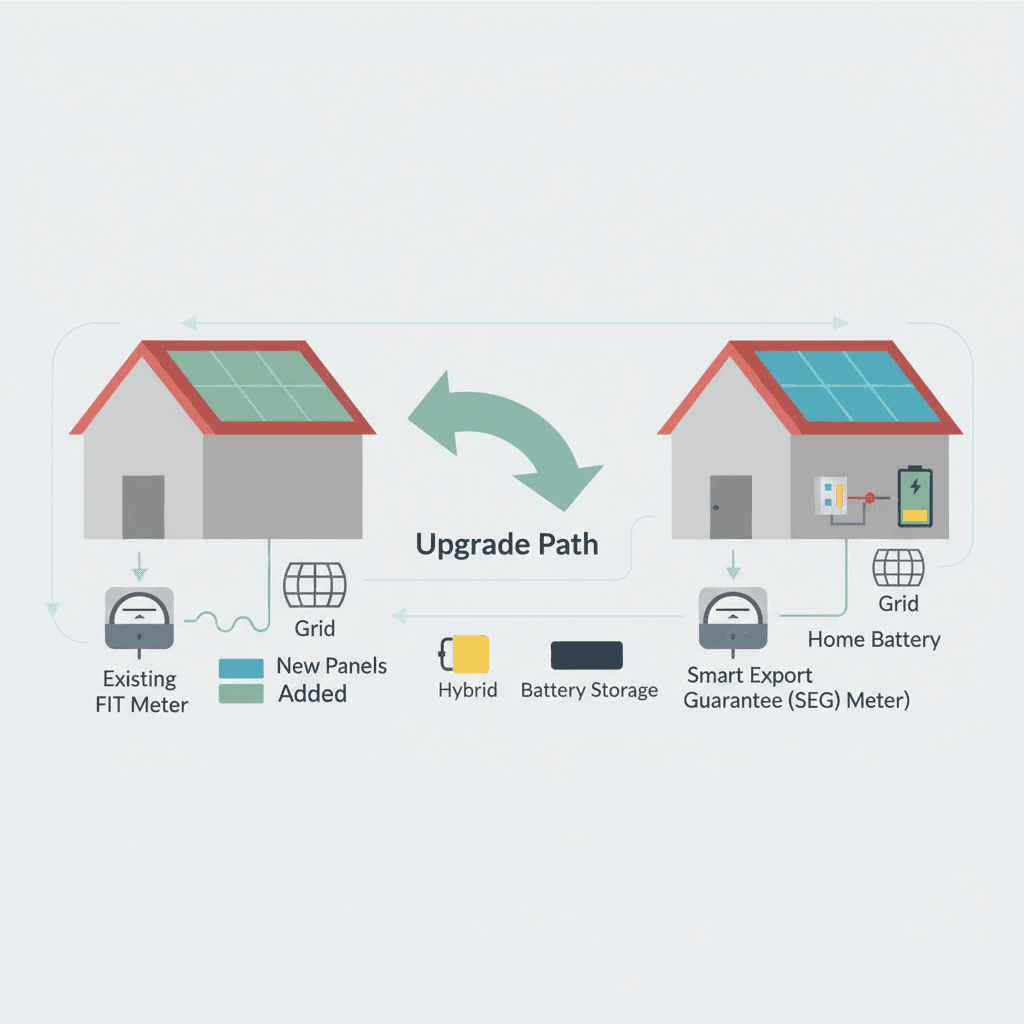
If you have a solar system on the feed-in tariff (FiT), you might think you are stuck with your original setup forever. You are not — but what you can change and what you get paid for are two different things.
Your FiT generation payments stay with the capacity your installation was accredited at, at your existing tariff rate, for the rest of your FiT term. Replacing panels like for like, or with more efficient panels of the same capacity, does not change that. Since a December 2021 Ofgem policy change you can also extend an accredited installation — up to 5 MW in total — and keep its accreditation for the original capacity. The catch is that the added capacity earns nothing under FiT: to be paid for what it exports you use the Smart Export Guarantee (SEG).
Key Points
- Generation payments continue at your originally accredited capacity, at your existing tariff rate, for the rest of your FiT term
- Like-for-like panels, or more efficient panels of the same capacity, do not change those payments
- Ofgem's December 2021 policy change lets an accredited installation be extended (5 MW total or less) while keeping accreditation for the original capacity
- Added capacity is not paid under FiT — it can earn export income through the Smart Export Guarantee (SEG) instead
- Ofgem and your FiT licensee (the supplier that pays you) must both be notified; where meters are shared, payments are pro-rated
- FiT export is usually deemed (an assumed 50% of generation); SEG pays for actual metered export
- Batteries are allowed, but your licensee must be satisfied that grid electricity used to charge them is not counted as generation
Common Misconceptions
- Any change voids my FiT - False. An accredited installation can be modified and even extended. What changes is what you are paid for, not whether you are paid.
- More panels means more FiT income - No. Added capacity is not paid under FiT; the extra output only earns through self-consumption and SEG export.
- I can't add batteries to a FiT system - You can. Your licensee has to be satisfied that grid electricity used to charge the battery is not counted as generation, and what they need to see varies by licensee.
- FiT export payments are always better - Not necessarily. FiT export is usually deemed at 50% whatever you really export; SEG pays for what your meter records.
- I have to choose between FiT generation and SEG export - You don't. Keeping FiT generation payments while moving export to SEG is the normal route.
Real-World Advice
A typical 4kW FiT system from 2012 produces less than a modern equivalent, both because panels age and because efficiency has moved on. Replace those panels with better ones of the same capacity and your generation tariff is untouched — every extra kWh is paid at the rate you already have.
Add capacity beyond what you were accredited for and the picture splits in two: the original capacity keeps its FiT tariff, while the added capacity earns only what you use at home plus what you are paid for exporting it.
Export is where most of the gain usually sits. Under FiT most domestic systems are on a deemed export — your licensee assumes you export 50% of generation whatever you actually do — while SEG pays for actual metered export. SEG rates vary by supplier, 3p–16.5p per kWh across the market, with some suppliers currently paying around 12p per kWh at the time of writing (September 2026). Export well above the deemed half and metered SEG usually pays more; use most of your generation at home and the 50% assumption can be the better deal.
UK-Specific Considerations
Telling Ofgem and your licensee: Both must be notified when the installation changes — Ofgem administers the scheme, your FiT licensee pays you. Where a meter is shared between the original installation and an extension, payments are pro-rated.
DNO notification: Changes to generation equipment normally have to be notified to your Distribution Network Operator. Whether that means a G98 notification or a full G99 application depends on the change and on your existing connection agreement, so have your installer confirm which applies.
Metering for batteries: Your licensee must be satisfied that grid electricity used to charge a battery is not counted as generation. Requirements vary by licensee — ask yours rather than assuming a particular meter is always required.
Documentation: Expect to supply a line diagram showing whether the battery is AC-coupled or on a hybrid inverter, plus MCS paperwork for the work carried out.
Your own tariff rate: FiT rates are index-linked and change each April (CPI-indexed from April 2026), so take your rate from your latest FiT statement.
Before You Spend Money
Check your current FiT rate - Take it from your latest FiT statement. Rates differ by accreditation date and change every April, so a headline figure from a website is not your figure.
Work out what you actually export - Deemed export assumes 50% of generation. Well above that and metered SEG is likely to pay more; below it and the deemed assumption may already be in your favour.
Be clear about what added capacity earns - Extra panels do not increase your FiT generation payments. Budget them against self-consumption and SEG income only.
Ask your FiT licensee what they need - Especially for batteries: metering and evidence requirements are easier to design in than to retrofit.
Assess roof space - Sometimes a separate system is simpler than extending the accredited one.
Budget for admin - Notifying Ofgem, your licensee and the DNO takes time, and any meter change is arranged around it.
Frequently Asked Questions
Q: Will upgrading affect my FiT generation payments?
A: Your originally accredited capacity keeps its tariff rate for the rest of your FiT term, so like-for-like panels, or more efficient panels of the same capacity, change nothing. Capacity you add on top is not paid under FiT. Export is the part that can move: you can switch from FiT deemed export to the Smart Export Guarantee and be paid for actual metered export.
Q: Can I add more panels than I was accredited for?
A: Yes. Ofgem's December 2021 policy change lets an accredited installation be extended, up to 5 MW in total, while keeping its accreditation for the original capacity. The extension earns nothing from FiT but can be paid for export under SEG.
Q: Who has to be told?
A: Ofgem and your FiT licensee must both be notified, and changes to generation equipment normally go to your DNO as well. Where meters are shared, payments are pro-rated.
Q: What metering do I need for a battery?
A: Enough for your licensee to be satisfied that grid electricity used to charge it is not counted as generation. The requirement varies by licensee, so confirm it before ordering equipment.
Q: Can I do this work myself?
A: No — you need an MCS-certified installer and the right network notifications for your payments to continue cleanly.
Summary
FiT upgrades are possible and often worthwhile — the rules simply decide where the money comes from. Your originally accredited capacity keeps its tariff rate for the rest of your term, added capacity earns nothing under FiT, and export can move from FiT's deemed 50% to SEG's actual metered export.
Get the process right and the risk largely disappears: notify Ofgem and your FiT licensee, confirm what your DNO needs, and agree the metering with your licensee before equipment is ordered. Modern panels, a battery or extra capacity can then be added without disturbing the payments you already have.
Sources
- Ofgem, Feed-in Tariff (FiT) guidance for renewable installations: https://www.ofgem.gov.uk/environmental-and-social-schemes/feed-tariffs-fit
Last reviewed: September 2026