
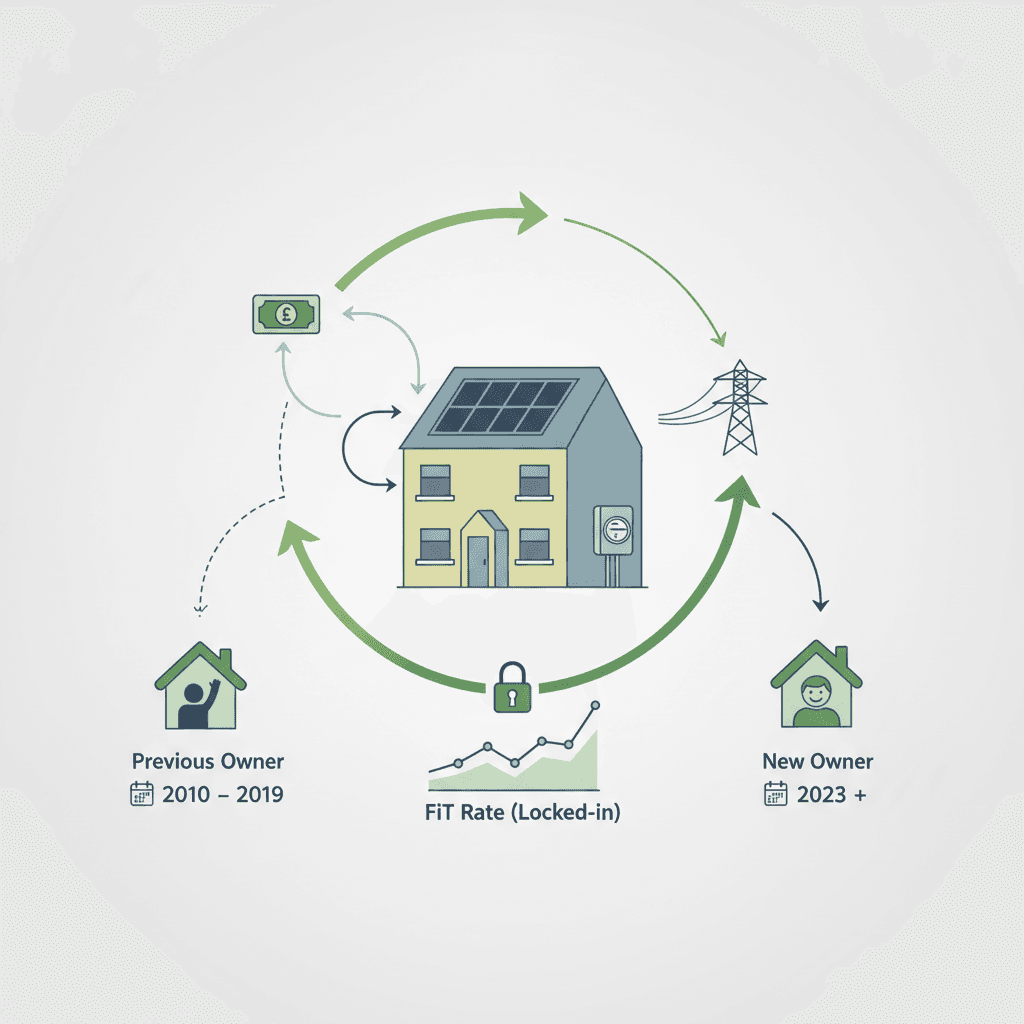
The Feed-in Tariff (FiT) scheme closed to new applicants in March 2019, but thousands of existing agreements are still running — some paying rates that were locked in back when the scheme launched in 2010. If you're buying a house that already has solar panels, there's a good chance the system is registered on the FiT scheme, which means the previous owner was being paid for the electricity those panels generated.
That income doesn't automatically transfer to you when you buy the property. You need to actively apply to take it over. Until you do, you won't see a penny — and if you're not careful during the conveyancing process, you might not even know the tariff exists.
Key Points
- The FiT scheme is closed to new applicants, but existing registrations can be transferred to a new owner when a property changes hands
- You need to apply directly to the energy company currently paying the FiT — this varies by property
- There is no hard deadline to transfer, but you will not be paid for any period before you complete the application and go live
- You'll typically need an MCS certificate, a G98 or G99 DNO commissioning certificate, proof of ID, and proof of property ownership
- The FiT statement from the previous owner — including the FiT ID number and the name of the paying supplier — is one of the most useful documents you can get during conveyancing
- Quarterly meter readings are required once you're registered with your FiT supplier
- FiT rates from different years vary significantly — check the Ofgem website for historical rate information
Common Misconceptions
- The FiT transfers automatically when I buy the house — It doesn't. You must make a separate application to the energy company paying the tariff. The solar panels belong to the house; the FiT agreement does not transfer by itself.
- If I miss a window, I lose the tariff permanently — The registration itself doesn't lapse, so the tariff should still be there waiting. However, you will only be paid from the point you go live with your FiT supplier. Any period before that is lost income, not a cancelled agreement.
- My solicitor will sort all of this out — In practice, FiT transfers are often not handled well during conveyancing. Don't assume it's been dealt with. Ask specifically about it.
- If the previous owner never claimed it, it doesn't exist — If the system was properly installed and registered, the FiT agreement exists regardless of whether the previous owner claimed it. However, if it was never registered in the first place, there is no tariff to inherit — and there is no way to retrospectively join the closed scheme.
Real-World Advice
In practice, transferring a FiT can be more time-consuming than it sounds. Energy companies vary significantly in how straightforward they make this process. Some have online application forms that work smoothly; others require repeated phone calls and will ask for the same documents multiple times even after you've already submitted them.
Buyers who don't know to ask about the FiT during conveyancing can end up losing months of payments simply because nobody flagged it. The good news is that the tariff itself remains active — it doesn't expire because of a house sale — so even if there's a delay, the agreement is still there to claim. You just won't be paid retroactively for the gap.
UK-Specific Considerations
- DNO certificates: The G98 (for systems up to 3.68kW per phase) or G99 certificate is the document showing the system was properly notified to the Distribution Network Operator. This is separate from the MCS certificate and both are worth tracking down before or during conveyancing.
- Ofgem FiT register: Ofgem administers the FiT scheme and publishes historical tariff rate information. If you want to understand what rate the system is registered at, the Ofgem website is the place to check.
- FiT suppliers: Not all energy companies offer FiT payments — only a set group of licensed FiT suppliers are obligated to offer the scheme. The previous owner's FiT statement will tell you which company was paying them, and you'll need to apply to that same company to take over the agreement.
- Quarterly readings: Once registered, you'll be asked to submit a meter reading to your FiT supplier every quarter. Keep records of these.
- Generation meter: Make sure you know where the generation meter is located. This is what you'll be reading — not your import meter.
When This Isn't Right For You
This process only applies if the solar system was properly installed and registered under the Feed-in Tariff scheme before it closed in March 2019. It is not relevant if:
- The panels were installed after March 2019 (those would be on the Smart Export Guarantee instead, which is a separate and simpler arrangement)
- The system was never registered for the FiT in the first place — in that case, there is no tariff to transfer and no way to retroactively join the closed scheme
- The system is owned by a third party under a lease or rent-a-roof arrangement, in which case the FiT may belong to the installation company, not the homeowner — this needs to be checked carefully before purchase
Before You Spend Money
Before you complete your property purchase, ask your solicitor to request the following from the seller:
- The FiT statement — this should show the FiT ID number and the name of the energy company making payments
- The MCS certificate — confirms the system was installed to the required standard
- The G98 or G99 DNO certificate — confirms the system was properly notified to the network operator
- Confirmation of who owns the panels — particularly important if the property had a free solar panel or rent-a-roof scheme installed
Once you've completed the purchase:
- Contact the FiT supplier as soon as possible and begin the transfer application
- Be prepared to provide proof of ID and proof that you now own the property
- Keep copies of everything you send
- Be persistent — some suppliers are slow and may ask for the same information more than once
- Find out where the generation meter is and take a reading on the day you move in
Frequently Asked Questions
Q: Is there a deadline to transfer the FiT after buying a property?
A: There is no fixed deadline, but you will only be paid from the date you complete your application and go live with the FiT supplier. The longer you leave it, the more income you miss out on. There's no penalty for a late transfer, but there's no back-payment either.
Q: What if the previous owner didn't tell me about the FiT?
A: This is more common than it should be. Check with your solicitor whether FiT documents were requested during conveyancing. If you have the MCS certificate, you can try contacting major FiT suppliers directly to check whether the system is registered. The Ofgem website also holds FiT scheme information.
Q: The FiT is registered with a supplier I don't want to use for my home energy — do I have to switch to them?
A: You don't have to use the FiT supplier for your household electricity supply. The FiT arrangement is separate from your normal energy tariff, and you can shop around for your household supply independently.
Q: How often do I need to submit meter readings?
A: Your FiT supplier will ask for a generation meter reading every quarter. It's worth setting a reminder and keeping a log of your readings in case of any disputes.
Q: What if the panels are under a lease or rent-a-roof agreement?
A: This is a completely different situation and needs careful legal attention before you buy. The FiT payments in that case likely belong to the company that owns the panels, not you. Make sure your solicitor reviews the lease terms thoroughly — these agreements can run for 25 years and may affect your ability to sell or modify the property.
Q: Can I find out the FiT rate before I commit to buying the property?
A: Yes — ask the seller for their FiT statement, which will show the tariff rate. You can also check historical FiT rates on the Ofgem website to understand what rate the system would have been registered at based on its installation date.
Summary
Inheriting a Feed-in Tariff when you buy a house with solar panels can be financially worthwhile, but it doesn't happen automatically. You need to apply to the energy company currently holding the FiT registration, provide proof of ID and ownership, and submit the right documents — ideally including the MCS certificate, DNO certificate, and the previous owner's FiT statement.
There's no deadline, but every month you delay is income you won't get back. Some suppliers make this process easy; others (notably some of the larger ones) can be slow and repetitive in their requests, so patience and good record-keeping help.
If the system was never registered for the FiT, or if the panels are owned by a third party, the situation is more complicated — check this before you buy, not after. And if you're in any doubt, ask your solicitor to specifically request FiT documentation during conveyancing, because it's often overlooked.